Ai in KanjiMeanings & Tattoo Guide
愛 (ai) means love, 藍 (ai) means indigo, and Ai is a popular Japanese name. Compare the kanji read "ai," their real meanings, and how to write the name Ai correctly.
At a Glance
| Kanji | Meaning | Reading | Strokes | Tattoo |
|---|---|---|---|---|
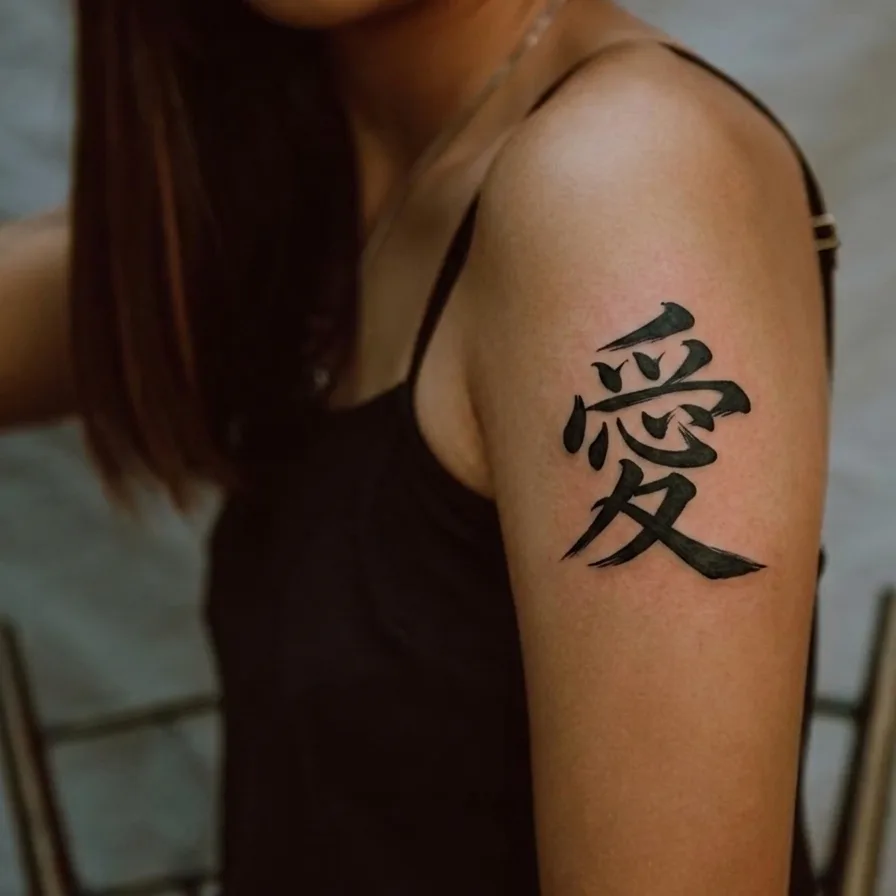
| 愛 | Love, affection, devotion | ai | 13 | excellent |
| 藍 | Indigo, deep blue | ai | 18 | excellent |
| 相 | Mutual, reciprocal, together | ai | 9 | good |
| 娃 | Beautiful, lovely (name kanji) | ai | 9 | fair |
Not sure which one fits your meaning? “Ai” can translate differently depending on context.
Check your kanji for free →See it on your body

Forearm · vertical
Drag the kanji to move it.
This sits comfortably on a typical forearm.
The classic spot — a vertical column of kanji follows the arm naturally.
Mistakes are permanent — the check is free.
愛 — Love, affection, devotion
愛 is by far the most common kanji read "ai," and it means love in its broadest sense — romantic, familial, platonic, and spiritual all at once. At its center sits 心 (heart), surrounded by strokes traditionally read as a figure walking slowly back to look after someone. Imported from Chinese and fully naturalized, 愛 appears everywhere from Buddhist compassion (慈愛) to patriotism (愛国) to everyday affection. It is also one of the most popular kanji for the female given name Ai.
Extremely common in every register. Found in 愛情 (aijou — affection), 愛する (ai suru — to love), 恋愛 (renai — romantic love), and as the name 愛 (Ai). When someone says they want "the kanji for ai," 愛 is almost always what they mean.
The most recognizable, culturally safe kanji read "ai." Its 13 strokes look beautiful from clean modern type to traditional brush calligraphy, and the meaning — love — is universally understood with no hidden connotations. The default choice for both the word "love" and the name Ai.
藍 — Indigo, deep blue
藍 is the deep indigo blue of traditional Japanese dye (藍染め, aizome) — the color long known abroad as "Japan Blue." The character reads "ai" and carries connotations of craftsmanship, nature, and quiet depth. It is also a popular given name (Ai, sometimes Ran), chosen for its serene, elegant image. Unlike 愛, 藍 points to a color and a natural material rather than an emotion.
Seen in 藍色 (ai-iro — indigo color), 藍染め (aizome — indigo dyeing), and as the name 藍 (Ai). Common in craft, fashion, and naming contexts; less common in everyday conversation, which gives it a refined, distinctive feel.
A distinctive, elegant alternative to 愛 for anyone named Ai or drawn to the meaning "indigo." The 18 strokes create a rich, intricate character that shines in brush calligraphy, and the nature-and-color meaning is unambiguous and positive. Far less common as a tattoo, so it reads as a considered, personal choice.
相 — Mutual, reciprocal, together
相 combines 木 (tree) and 目 (eye) — originally an eye looking closely at a tree — and carries the sense of two things facing and relating to each other. Read "ai" in many native compounds, it expresses mutuality and togetherness: doing something to or with each other. It appears in words about partnership, harmony, and shared action, making it a quietly meaningful choice for bonds between two people.
Read "ai" in 相生 (aioi — growing together / shared origin), 相棒 (aibou — partner, buddy), and 相槌 (aizuchi — responsive nods in conversation). It also reads "sou" in many words (相談 soudan — consultation). The "ai" reading specifically evokes mutual connection.
A thoughtful choice for themes of partnership and mutual bonds — popular for matching tattoos. The 9 strokes are clean and balanced at most sizes. Note that 相 alone is abstract: a Japanese reader sees "mutual / aspect" rather than a finished word, so it works best when the intended nuance is partnership rather than "love" itself.
娃 — Beautiful, lovely (name kanji)
娃 is a rarer kanji read "ai," meaning a beautiful or lovely woman. It is a 人名用漢字 (jinmeiyō — character approved for use in names) rather than an everyday word, so almost the only place you'll meet it is in the female given name Ai. Its left side is 女 (woman), and the right side 圭 lends it an auspicious, refined tone.
Essentially name-only today. Parents who want the name Ai to specifically evoke "beauty" sometimes choose 娃 over 愛 or 藍. It is not used in ordinary vocabulary, so most Japanese readers recognize it only as a name character.
Meaningful and uncommon if your name is Ai and you want "beauty" rather than "love," but its rarity is a double-edged sword: many Japanese readers won't recognize it on sight and may misread it. Choose it only if the personal, name-specific meaning matters more than instant readability.
Font Style Preview
See how each kanji looks in different Japanese font styles.
| Font | 愛 | 藍 | 相 | 娃 |
|---|---|---|---|---|
| Serif | 愛 | 藍 | 相 | 娃 |
| Sans | 愛 | 藍 | 相 | 娃 |
| Yuji Mai | 愛 | 藍 | 相 | 娃 |
| Yuji Syuku | 愛 | 藍 | 相 | 娃 |
| Kouzan Syodou | 愛 | 藍 | 相 | 娃 |
| Tamanegi Geki | 愛 | 藍 | 相 | 娃 |
Common Mistakes to Avoid
哀 is also read "ai," looks similar to 愛, and is one of the most dangerous mix-ups for an "ai" tattoo. It means sorrow, grief, and pathos — the exact opposite of the warm feeling most people are after. Always double-check you have 愛 (heart 心 in the middle) and not 哀, or your tattoo will read as "grief."
If you searched "ai kanji" meaning AI the technology, note there is no single traditional kanji for artificial intelligence — Japanese writes it 人工知能 (jinkou chinou) or simply borrows the letters "AI." The single kanji 愛 reads "ai" but means love, not machine intelligence. Make sure you know which "ai" you actually want before committing it to skin.
Context-specific errors are harder to catch. The kanji for “love, the emotion” vs “indigo, the color” vs “the given name Ai” each require different characters. A wrong choice isn't always obvious until a native speaker sees it.
Verify your phrase with AI before you ink →Frequently Asked Questions
This page covers generic “ai” — but your tattoo is personal
The right kanji depends on your exact phrase, intended nuance, and personal context. Our AI translates your specific meaning into authentic Japanese — with cultural verification and tattoo-ready exports.
Verify your kanji before you ink →